
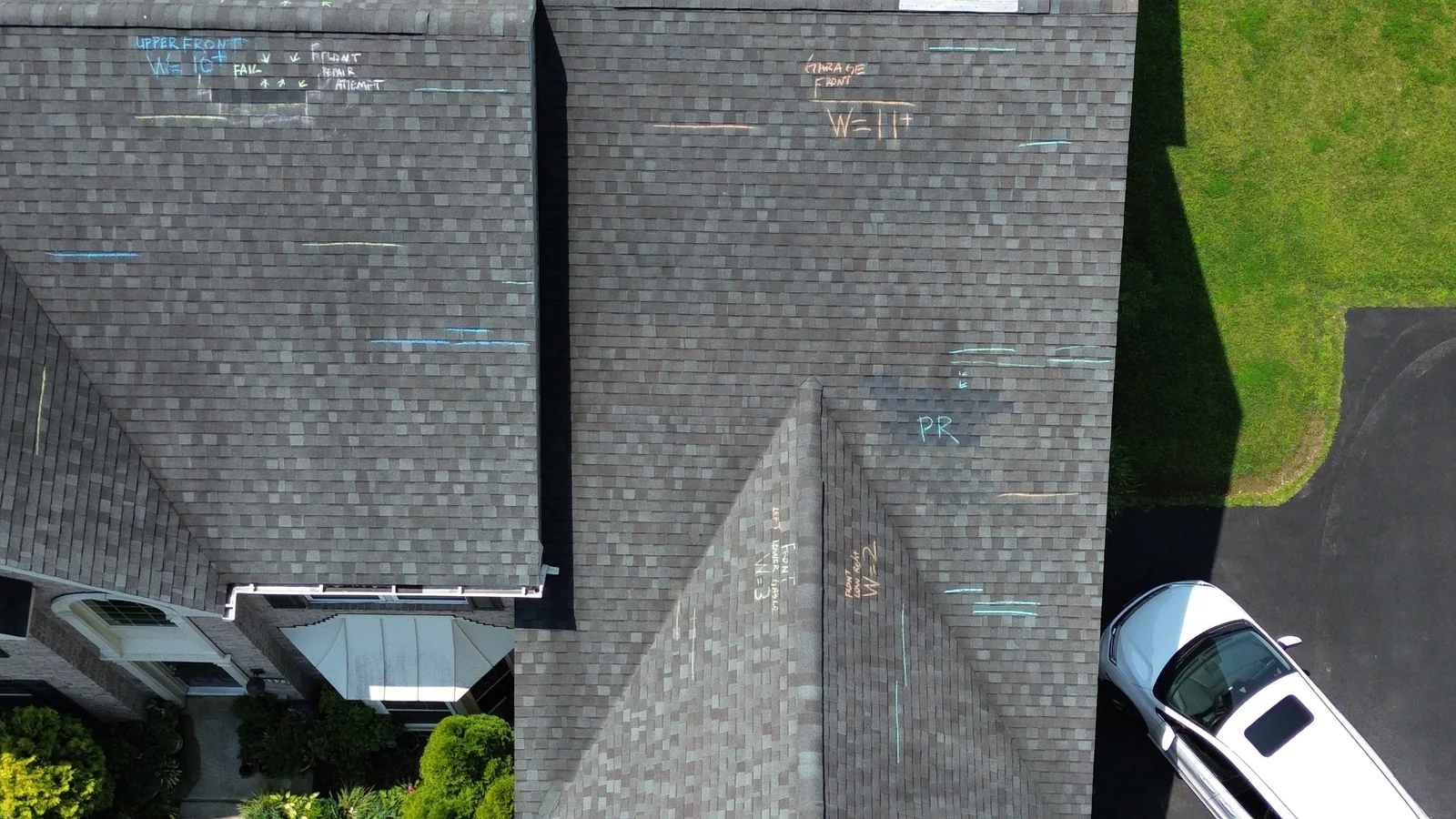
Roofing estimates for the same house can look wildly different. Usually that's because the bids aren't describing the same job. This guide explains how a roof replacement is priced, what a complete estimate should include, and the Harford County rules that apply.
The short answer
The price of a new roof depends on:
- Roof area, measured in squares of 100 square feet. That's the roof, not the floor area of your house.
- Pitch and complexity. Steep roofs, dormers, valleys, and multiple levels take longer and need more safety setup.
- Tear-off. How many layers come off and how much debris has to be hauled away.
- Decking. Whether any of the wood sheathing underneath is soft or rotted.
- Details. Flashing at chimneys, walls, and skylights, plus underlayment, drip edge, and ventilation.
- Material. Architectural asphalt shingles, metal, or a membrane for low-slope sections.
Roof area isn't house size
Roofers measure the roof itself. Because of its slope and overhangs, a roof covers more area than the floor beneath it. A one-story rancher and a two-story colonial with the same living space can have very different roofs, and garages, porches, and additions add area too.
When you compare estimates, check that each one is based on about the same number of squares. If one is much lower, ask how they measured.
Pitch, access, and complexity
A low, simple roof lets a crew work quickly. Each of these adds labor:
- A steep pitch, which calls for roof jacks, harnesses, and slower, more careful work.
- Valleys, dormers, hips, and walls, all of which need flashing.
- Several roof levels, or a roof that's hard to reach with materials and a dumpster.
- Skylights and chimneys, each with its own flashing work.
Tear-off and decking
Most replacements start by stripping the old roof down to the wood deck, which is when the decking gets inspected. Plywood or boards that are soft, delaminated, or rotted have to be replaced before new roofing goes on. Nobody can know exactly how much until the old roof is off, so a good estimate says how damaged decking will be handled and priced.
What a complete roof estimate covers
Beyond the shingles, look for:
- Underlayment over the entire deck.
- Ice and water membrane wherever the shingle manufacturer calls for it (more on that below).
- Drip edge along the eaves and rakes.
- Flashing at chimneys, walls, and skylights. Reusing old flashing saves money up front, but worn flashing is a common source of leaks.
- Pipe boots around plumbing vents.
- Ventilation, such as a ridge vent, so the attic can breathe.
- Cleanup and disposal, including a sweep for stray nails.
- Warranties. The shingle manufacturer's warranty and the contractor's workmanship warranty are two different things. Ask about both.
Choosing a material
| Material | Best fit | Typical life expectancy* |
|---|---|---|
| Architectural asphalt shingles | Most pitched roofs | About 30 years |
| 3-tab asphalt shingles | Budget replacements | About 20 years |
| Metal | Long-term owners who want low maintenance | 40 to 80 years |
| EPDM rubber membrane | Low-slope roofs, porches, additions | 15 to 25 years |
| TPO membrane | Low-slope roofs | 7 to 20 years |
*From InterNACHI's life expectancy chart. Actual life depends on weather, installation, ventilation, maintenance, and material quality.
Architectural shingles are a common choice for pitched residential roofs. Metal costs more up front but can outlast more than one shingle roof. Shingles aren't made for flat or very low-slope sections; those need a low-slope system such as a membrane.
Harford County rules for roof replacement
Harford County's residential roof replacement guidelines, revised in April 2026, make a few points worth knowing:
- Like-for-like replacement is an "ordinary repair." Replacing roofing with the same kind of material for maintenance doesn't require a permit application. That includes replacing sheathing damaged by water or mold.
- Some work does need a permit. Switching to a material that wasn't previously approved for the roof, or replacing fire-retardant-treated (FRT) sheathing, requires a building permit before work starts.
- The code applies either way. Permit or not, the work has to meet the county's building code, which is based on the 2021 International Residential Code.
- Ice and water shield depends on the product. The county doesn't require an ice barrier across the board, but the code treats the manufacturer's installation instructions as part of the code. If the shingle manufacturer calls for ice and water membrane, it's required.
Questions about a specific project can go to the county's Building Services Division at 410-638-3366.
Will insurance pay for it?
Only if a covered event caused the damage. The Maryland Insurance Administration explains that homeowners policies typically cover sudden and accidental losses from perils such as fire, wind, hail, and the weight of ice or snow, and that they don't cover maintenance. A roof that has simply worn out is a maintenance item. And if only part of a roof is damaged, the policy may pay to repair just that part.
The MIA also warns about roofers who show up uninvited, offering free inspections to generate insurance claims. Some misrepresent ordinary wear as storm damage. If a stranger knocks after a storm, check their MHIC license before anyone climbs on your roof.
Repair or replace?
If you're dealing with a leak rather than an old roof, a repair may be all you need. Our guide to roof leaks, repair or replace, walks through how to tell.
Before you sign
- Confirm the license. Roofing is home improvement work in Maryland, so your contractor needs a Maryland Home Improvement Commission license. Ours is MHIC #166563.
- Get it in writing. The contract should name the materials, describe the work, and give approximate start and completion dates.
- Keep the deposit legal. Maryland caps a home improvement deposit at one-third of the contract price.
See our roofing services for the roofs we install and repair.
Sources
- Harford County: Residential Roof Replacement Guidelines (revised April 9, 2026)
- Maryland Insurance Administration: roof replacement and homeowners insurance
- Maryland Home Improvement Commission: home improvement contracts
- InterNACHI: Standard Estimated Life Expectancy Chart for Homes